The Anti-Aging Signal: 3 Progressive Moves Women Over 30 Must Master
Women over 30 lose up to 8% of their muscle mass per decade—and the #1 thing most are doing to "stay fit" is making it worse.
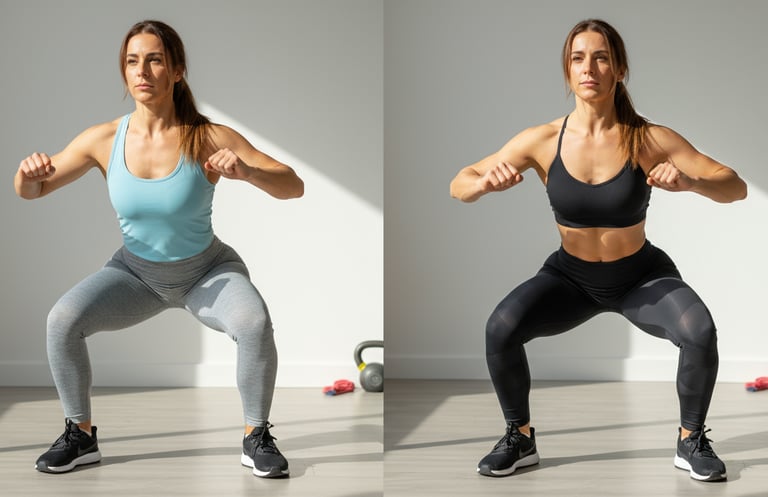
"Same woman. Six years apart. One signal changed everything."
The Reversal Nobody Warned You About
Between 1950 and 2000, women got stronger, healthier, and lived longer with each passing decade. Medical advances, better nutrition, and increased access to fitness created what researchers called "the longevity boom."
Then, around 2010, something shifted.
A 2019 study published in JAMA Internal Medicine found that despite more women exercising than ever before, rates of metabolic dysfunction, bone density loss, and age-related muscle decline were accelerating in women over 30.
Not slowing down. Speeding up.
The researchers were puzzled. Women were moving more, tracking their steps, hitting their cardio goals. So why were their bodies aging faster?
The answer, it turns out, wasn't about how much women were moving.
It was about what signal they were sending their bodies while they moved.
And for millions of women over 30, that signal has been quietly catastrophic.
The Signal Your Body Hears When You Do Cardio
Here's what most women don't know about how their bodies respond to exercise after 30:
Your body doesn't "hear" your intentions. It doesn't know you're trying to lose fat or get toned or fit into your jeans from three years ago.
It only hears the signal you send through movement.
And cardio—especially steady-state cardio done repeatedly without strength training—sends a very specific message:
"We need to do more with less. Shed anything that's metabolically expensive. Become efficient."
Your body interprets this as a survival directive.
So it does exactly what you're asking: it becomes more efficient by shedding the most metabolically "expensive" tissue you have.
Muscle.
Dr. William Evans, one of the leading researchers on sarcopenia (age-related muscle loss), has spent 40 years studying this phenomenon. His conclusion is stark:
"Muscle is the organ of longevity. Lose it, and you don't just lose strength—you lose your metabolic resilience, your bone density, your hormonal balance, and your functional independence."
A 2014 review in Ageing Research Reviews confirmed that women can lose between 3% and 8% of their muscle mass per decade after 30—and that rate accelerates after 40.
But here's the part that should terrify you:
Most women don't notice the loss until it's already severe.
You don't wake up one day and realize you've lost 15 pounds of muscle over five years. You just notice that:
Your jeans fit differently (loose in the legs, tight in the waist)
You're exhausted by 2 PM most days
Your lower back hurts when you stand too long
You feel "soft" even though you're working out
You're eating less but somehow gaining weight
This isn't aging. This is adaptive thermogenesis—your body's survival response to chronic cardio and calorie restriction.
And the cruel irony?
The harder you work, the worse it gets.
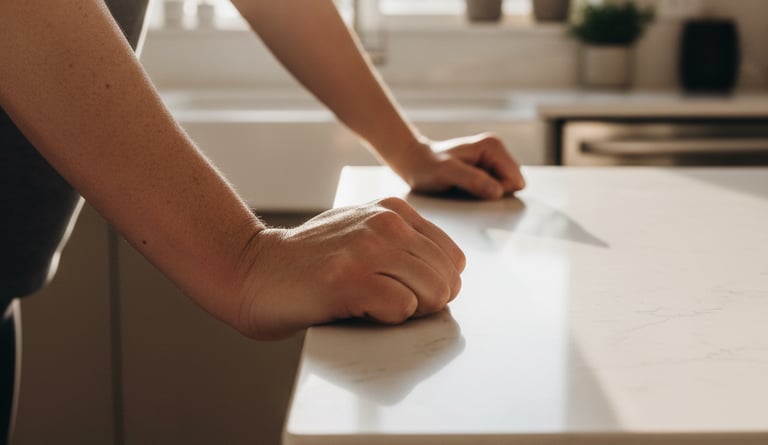
"Your kitchen counter is about to become your most powerful anti-aging tool."
The One Signal That Reverses the Decline
In 2011, researchers at McMaster University did something interesting.
They took two groups of women in their 40s and 50s. Both groups were sedentary. Both had similar body compositions and metabolic markers.
Group 1 did 45 minutes of moderate cardio, three times per week.
Group 2 did 30 minutes of progressive bodyweight strength training, three times per week.
After 16 weeks, here's what happened:
Group 1 (Cardio):
Lost an average of 4 pounds
Saw minimal changes in body composition
Reported feeling "about the same" in terms of energy and strength
Group 2 (Strength):
Lost an average of 2 pounds on the scale
Lost significantly more body fat (despite losing less "weight")
Gained measurable muscle mass
Reported feeling "stronger, more energetic, and more capable"
But the most interesting finding wasn't about weight or even body composition.
It was about bone density.
The strength training group showed measurable improvements in bone mineral density at the spine and hips—the two most common fracture sites as women age.
The cardio group? No change.
A 2018 study in Osteoporosis International went even further, showing that women who did progressive resistance training had a 29% lower risk of hip fracture over a 10-year period compared to women who only did cardio.
Let me say that again: 29% lower risk.
Not from taking a supplement. Not from eating more calcium.
From sending their bodies a different signal.
What "Progressive Overload" Actually Means (Without the Gym Bro Nonsense)
If you've spent any time on fitness Instagram, you've probably seen the term "progressive overload" thrown around like it's some advanced, complicated concept.
It's not.
Progressive overload simply means:
Gradually asking your body to do a little more over time so it has a reason to adapt.
That "more" can be:
More reps (8 squats → 10 squats)
More sets (2 sets → 3 sets)
Slower tempo (3 seconds down instead of 1)
More challenging variation (wall push-up → incline push-up → knee push-up)
You're not trying to break yourself. You're not chasing soreness or exhaustion.
You're simply nudging your body forward, week by week, so it has a reason to keep the muscle it has—and maybe even build a little more.
This is the signal that reverses the decline.
And the best part?
You don't need a gym. You don't need weights. You don't even need more than 30 minutes, three times a week.
You just need three movement patterns, done progressively, with intention.
The 3 Non-Negotiable Movement Patterns for Women Over 30
These three patterns form the foundation of every effective strength program for women over 30. They target the muscle groups that decline fastest, protect the joints most vulnerable to injury, and send the loudest "build and preserve" signal to your body.
And all three can be done with just your bodyweight.
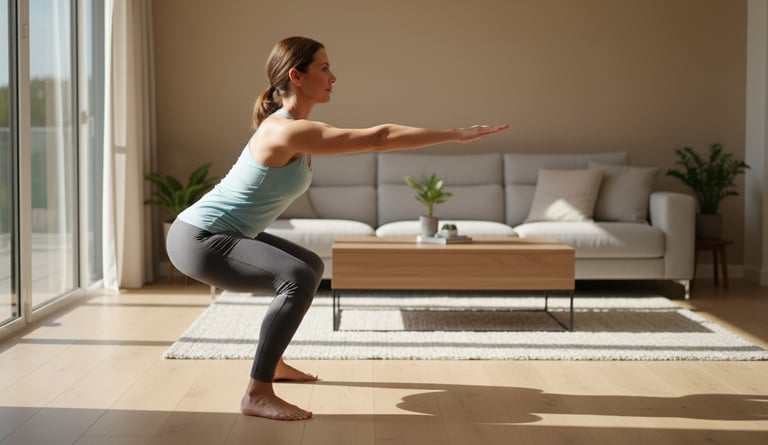
Move #1: The Squat – Your Metabolic and Bone Density Anchor
The squat is the single most important movement pattern for women over 30.
It targets your quads, glutes, hamstrings, and core—the largest muscle groups in your body. And because it loads your spine and hips, it sends a direct signal to your bones:
"We need you strong."
A 2017 study in The Journal of Bone and Mineral Research found that women who performed regular squatting movements had significantly higher bone mineral density at the lumbar spine and femoral neck compared to women who didn't.
Translation: Squats don't just build muscle. They build the scaffolding that keeps you upright and fracture-free as you age.
The One Signal That Reverses the Decline
In 2011, researchers at McMaster University did something interesting.
They took two groups of women in their 40s and 50s. Both groups were sedentary. Both had similar body compositions and metabolic markers.
Group 1 did 45 minutes of moderate cardio, three times per week.
Group 2 did 30 minutes of progressive bodyweight strength training, three times per week.
After 16 weeks, here's what happened:
Group 1 (Cardio):
Lost an average of 4 pounds
Saw minimal changes in body composition
Reported feeling "about the same" in terms of energy and strength
Group 2 (Strength):
Lost an average of 2 pounds on the scale
Lost significantly more body fat (despite losing less "weight")
Gained measurable muscle mass
Reported feeling "stronger, more energetic, and more capable"
But the most interesting finding wasn't about weight or even body composition.
It was about bone density.
The strength training group showed measurable improvements in bone mineral density at the spine and hips—the two most common fracture sites as women age.
The cardio group? No change.
A 2018 study in Osteoporosis International went even further, showing that women who did progressive resistance training had a 29% lower risk of hip fracture over a 10-year period compared to women who only did cardio.
Let me say that again: 29% lower risk.
Not from taking a supplement. Not from eating more calcium.
From sending their bodies a different signal.
What "Progressive Overload" Actually Means (Without the Gym Bro Nonsense)
If you've spent any time on fitness Instagram, you've probably seen the term "progressive overload" thrown around like it's some advanced, complicated concept.
It's not.
Progressive overload simply means:
Gradually asking your body to do a little more over time so it has a reason to adapt.
That "more" can be:
More reps (8 squats → 10 squats)
More sets (2 sets → 3 sets)
Slower tempo (3 seconds down instead of 1)
More challenging variation (wall push-up → incline push-up → knee push-up)
You're not trying to break yourself. You're not chasing soreness or exhaustion.
You're simply nudging your body forward, week by week, so it has a reason to keep the muscle it has—and maybe even build a little more.
This is the signal that reverses the decline.
And the best part?
You don't need a gym. You don't need weights. You don't even need more than 30 minutes, three times a week.
You just need three movement patterns, done progressively, with intention.
The 3 Non-Negotiable Movement Patterns for Women Over 30
These three patterns form the foundation of every effective strength program for women over 30. They target the muscle groups that decline fastest, protect the joints most vulnerable to injury, and send the loudest "build and preserve" signal to your body.
And all three can be done with just your bodyweight.
Move #1: The Squat – Your Metabolic and Bone Density Anchor
The squat is the single most important movement pattern for women over 30.
It targets your quads, glutes, hamstrings, and core—the largest muscle groups in your body. And because it loads your spine and hips, it sends a direct signal to your bones:
"We need you strong."
A 2017 study in The Journal of Bone and Mineral Research found that women who performed regular squatting movements had significantly higher bone mineral density at the lumbar spine and femoral neck compared to women who didn't.
Translation: Squats don't just build muscle. They build the scaffolding that keeps you upright and fracture-free as you age.
"No gym. No weights. Just you, your living room, and the most powerful anti-aging move you can do."
Your 8-Week Squat Progression (Bodyweight Only):
Weeks 1-2: Box Squat
Sit back to a chair or bench, tap down lightly, stand up.
Focus: Control and balance.
3 sets × 8-10 reps, 2-3x per week
Weeks 3-4: Bodyweight Squat (No Chair)
Same reps and sets. Aim to go slightly deeper each week while keeping heels down.
3 sets × 8-12 reps
Weeks 5-6: Pause Squat
Hold the bottom position for 2-3 seconds before standing.
This increases time under tension without needing weights.
3 sets × 8-10 reps
Weeks 7-8: Tempo Squat
3 seconds down, 1 second pause, 1 second up.
Or add 2 reps per set (10 → 12).
3 sets × 10-12 reps
That's progressive overload. No reinventing the wheel. Just consistent, intelligent pressure.
Move #2: The Hinge – Protect Your Back, Power Your Posterior Chain
The hinge pattern is criminally underrated.
It targets your glutes, hamstrings, and lower back—the muscles responsible for posture, spinal stability, and explosive power.
Most women tell me, "My lower back hurts when I stand too long" or "I threw my back out picking up groceries."
That's not "getting old." That's weakness in your posterior chain.
And the fix is simpler than you think.
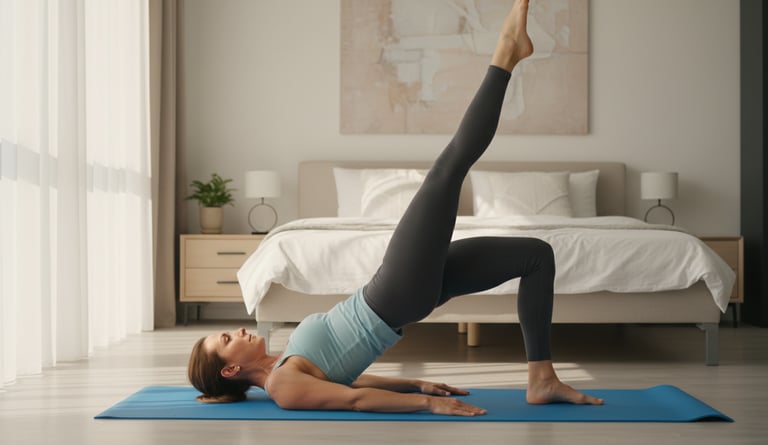
"This move saved my lower back—and it takes less than 5 minutes."
Your 8-Week Hinge Progression (Bodyweight Only):
Weeks 1-2: Glute Bridge
Lie on your back, knees bent, feet flat. Lift hips until your body forms a straight line from shoulders to knees.
3 sets × 12-15 reps, 2x per week
Weeks 3-4: Single-Leg Glute Bridge (Assisted)
Same position, but extend one leg straight. Keep hips level.
2-3 sets × 8-10 reps per leg
Weeks 5-6: Tempo Glute Bridge
3 seconds up, 2-second hold at the top, 3 seconds down.
3 sets × 10-12 reps
Weeks 7-8: Single-Leg Glute Bridge (Full)
Full single-leg version with no assistance.
3 sets × 8-10 reps per leg
This pattern doesn't just build a stronger back and glutes—it protects your spine and makes everyday tasks dramatically less risky.
Move #3: The Push – Future-Proof Your Upper Body
Upper body strength is the first thing to quietly disappear after 30.
You don't notice it until jars are harder to open, carrying groceries feels heavier, or you avoid push-ups in group classes because they feel "impossible."
But here's the truth:
You can build serious upper body strength with nothing but your body and a wall or counter.
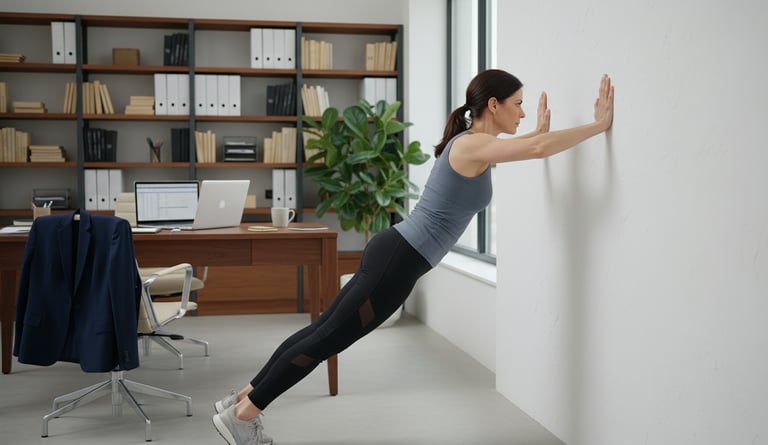
"Strength training doesn't require a gym—or even changing out of your work clothes."
Your 8-Week Push Progression (Bodyweight Only):
Weeks 1-2: Wall Push-Ups
Hands on the wall, step back, body in a straight line.
3 sets × 10-12 reps
Weeks 3-4: Incline Push-Ups (Counter or Bench)
Same sets and reps. Move your hands lower over time to increase difficulty.
3 sets × 10-12 reps
Weeks 5-6: Knee Push-Ups on the Floor
Focus on full range of motion—chest as close to the floor as possible.
3 sets × 6-10 reps
Weeks 7-8: Eccentric Push-Ups
Start in full push-up position. Lower yourself slowly (5 seconds), then drop to your knees to push back up.
3 sets × 4-6 reps
Again: we're not chasing perfection. We're chasing progress.
Two Women, Same Age, Different Signals
Let me tell you about two women. Names changed, stories real.
Sarah, 34
Sarah lived on her Peloton. Four to five rides a week. Light salads, low calories, "clean eating."
When we first talked, she said: "I don't understand. I'm doing everything right and my body just feels… soft."
She'd lost about 10 pounds over a year, but she was exhausted by 3 PM, her cycle was unpredictable, and she had knee pain going up stairs.
We shifted her to three days a week of progressive bodyweight strength (squat, hinge, push) and two days of lighter movement (walks, yoga, or short rides).
Eight weeks later, she sent me this:
"The scale only dropped 2 pounds… but my jeans fit better than when I was 10 pounds lighter. And I'm not tired anymore. What is this sorcery?"
It wasn't sorcery. It was muscle.
Lerato, 41
Lerato came in with a different story. She'd been avoiding training because every time she tried, she went "all in" and then burned out: six workouts in week one, zero in week three.
We picked three bodyweight moves as her non-negotiables: squat, glute bridge, incline push-up. Three days a week. 30-40 minutes. Zero obsession with calorie burn.
In 12 weeks, she:
Went from box squats to full tempo squats
Progressed from glute bridges to single-leg bridges
Moved from wall push-ups to knee push-ups
Reported better sleep, less PMS, and more energy at work
She didn't become a fitness influencer. She became stronger, calmer, and more in control of her body at 41 than she felt at 29.
Did both women still walk? Yes.
Did we throw cardio in the trash? No.
We just stopped pretending it was an anti-aging plan.
Your 5-Step Anti-Aging Strength Blueprint
Here's how to start next week—no equipment, no gym, no overwhelm.
Step 1: Choose Your Starting Variations
Pick one from each category based on where you are right now:
Squat: Box squat, bodyweight squat, or tempo squat
Hinge: Glute bridge or single-leg bridge
Push: Wall push-up, incline push-up, or knee push-up
Stick with the same variations for 8 weeks. Consistency beats variety when building strength.
Step 2: Train 3 Days Per Week
Three non-consecutive days (e.g., Mon, Wed, Fri). Aim for 30-40 minutes per session.
Simple Session Structure:
Squat variation: 3 × 8-12
Hinge variation: 3 × 10-15
Push variation: 3 × 8-12
Rest 60-90 seconds between sets
Step 3: Progress Gently Every 1-2 Weeks
You don't need to increase something every workout. But aim for tiny upgrades:
Add 2 reps per set (8 → 10)
Slow down the lowering phase (3 seconds down)
Add a pause at the hardest part (2-second hold)
Progress to the next variation
If your form breaks down, you've gone too far. Pull back and build slowly.
Step 4: Keep Cardio Supportive, Not Dominant
You don't need to break up with your treadmill.
Cardio That Supports Strength:
6,000-8,000 steps per day
1-2 sessions per week of 20-30 minutes light-to-moderate cardio (walks, cycling, dance)
Enough to support your heart and mood. Not so much that your body thinks you're running from danger all day.
Step 5: Respect Recovery Like It's Part of the Workout
After 30, your muscles and hormones care deeply about rest.
Recovery Habits:
Aim for 7-8 hours of sleep most nights
Eat enough protein (most women do better around 1.6-2.0 g/kg body weight)
Take at least one full rest day per week with nothing structured
This isn't about perfection. It's about sending your body a consistent "we're safe, we're strong, we're building" signal.
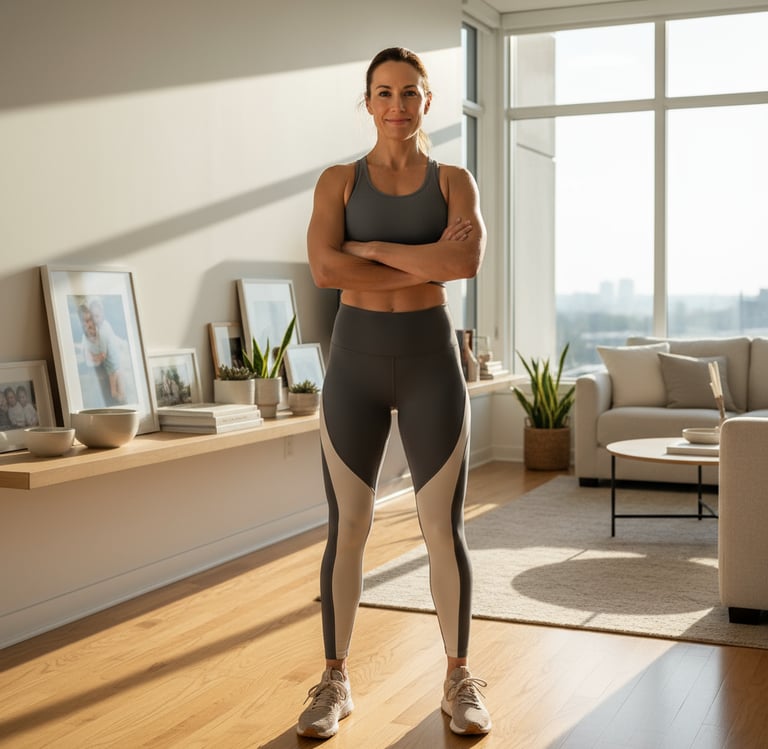
"This is what 38 looks like when you send your body the right signal."
Ready to Master These 3 Moves? Get the Complete System
I get it—this makes sense on paper, but you're already tired just trying to plan it.
After years of working with hundreds of women over 30, I built The 90-Day Fitness Plan for Women 30+ around these exact bodyweight pillars:
✅ Progressive overload without the guesswork
✅ Clear progressions for squats, hinges, and pushes you can do at home
✅ Weekly schedules that work for real women with jobs, kids, and a life
✅ Zero equipment required
You absolutely don't need my program to get stronger and feel younger in your body.
But if you want a done-for-you roadmap with every workout planned, every progression mapped out, and every question answered, here's how to get it:
📕 Get the Color Ebook ($17) →
Perfect for printing or reading on your tablet. Full-color photos, detailed form cues, and printable workout logs.
📚 Get the Kindle Edition ($14.99) →
Read on any device. Same complete system, optimized for Kindle.
These three bodyweight moves are at the heart of the entire program—and they're the same moves that helped Sarah fit into her jeans better at 34 than she did at 24, and Lerato feel stronger at 41 than she did at 29.
The Signal Your Body Has Been Waiting For
Between 1950 and 2000, women got stronger with each decade.
Then something shifted.
Not because we stopped caring. Not because we got lazy.
But because we started sending our bodies the wrong signal.
Cardio told our bodies to survive. To do more with less. To become efficient by shedding the very tissue that keeps us strong, metabolically resilient, and functionally independent.
Strength training tells your body something different:
"We need you strong. We need you capable. We need you here for the long haul."
Your body hasn't betrayed you.
It's just been answering the question you've been asking.
So here's the new question:
"Can we build something stronger here?"
The answer, as it turns out, is yes.
And it starts with three moves, three days a week, and one signal sent consistently over time.
About the Author
Gift Moralo is a fitness coach specializing in sustainable strength and body recomposition for women over 30. Helps women trade punishment workouts and diet culture for strength, confidence, and long-term health—all with bodyweight training that fits real life. Check this program, The 90-Day Fitness Plan for Women 30+, is available in the Store and on Kindle.